The Circle Part 3 - James DeNoon Reymert
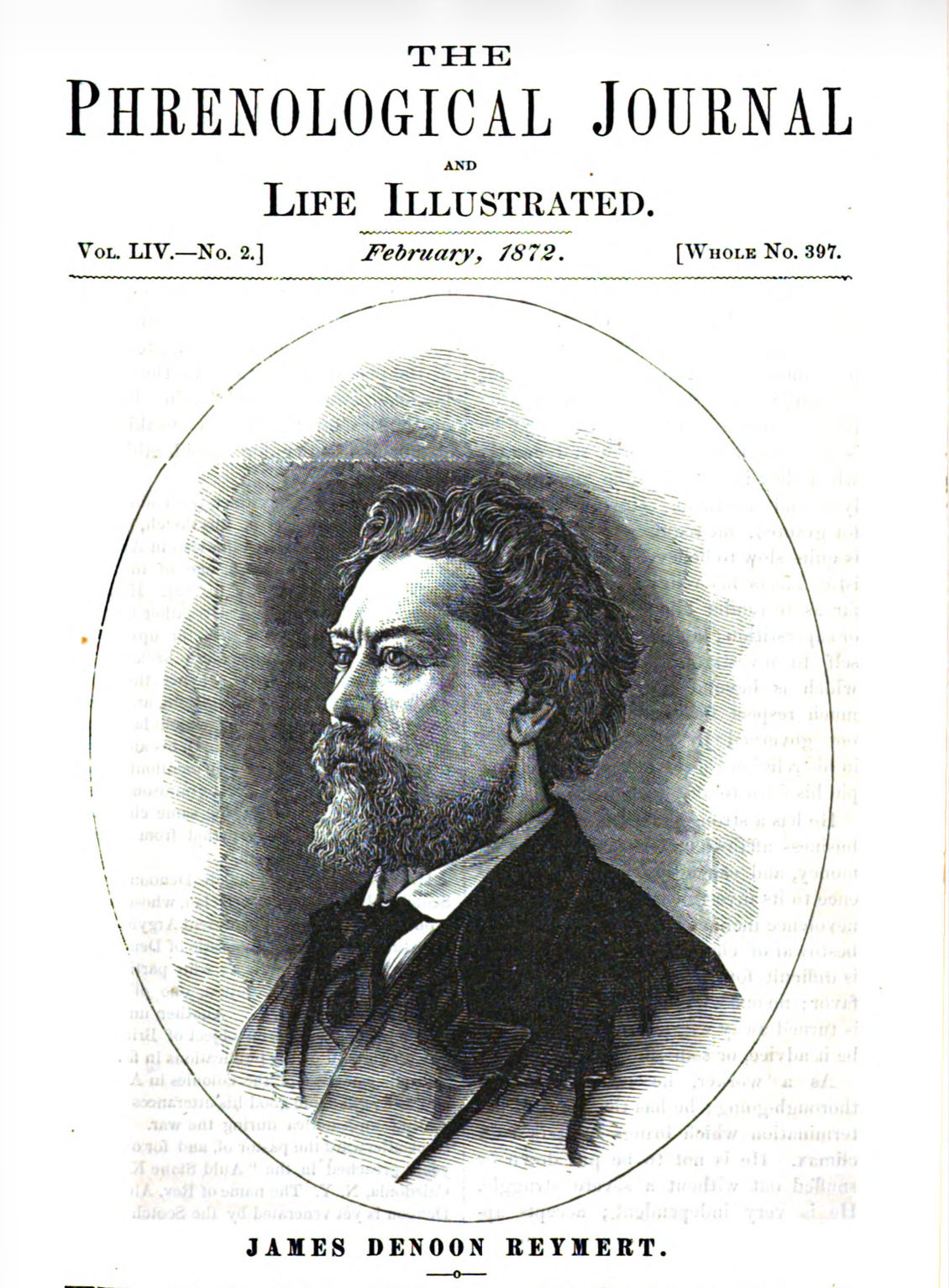
(James DeNoon Reymert on the cover of The Phrenological Journal. Feb. 1872.)
This is part 3 of a multi-part series. Read part 1 here. Read part 2 here.
The first article in this series introduced the Knights of the Golden Circle. In the second, we met suspected KGC leader and financier, Caleb Cushing, the doughface. This is the story of James DeNoon Reymert, the man Cushing chose as his partner.
In the summer of 1852, ship-fever and cholera swept through the Norwegian settlements that had risen up in southeastern Wisconsin. At the town of Norway in Racine County, the sickness struck the estate of JD Reymert, a 3,500-acre operation stocked with two thousand sheep, twenty horses, and a hundred head of cattle, with mills, workshops, a hotel, and a printing office spread across the vast property. Reymert employed more than a hundred workmen there. It was, for all intents and purposes, a growing town, and it was filling up fast with European emigrants. It was they, these European emigrants, who brought these diseases with them.
As the pestilence raged, death took off victims every hour. All the people who could flee the area fled, but because Reymert’s wife was in confinement with their latest born son, there was no escape for him. Determined, he improvised a hospital. Among the sick there was a man who had previously been a convict in Norway who was later pardoned for good behavior. He applied for a position in Reymert’s hospital, for the purpose of, as he said, doing as much good in the world as he had done evil. Reymert made him the chief steward. Doctor Squires, the only physician brave enough to care for patients at the hospital, fell before the scourge within days. Reymert mounted his horse and rode to Milwaukee for help. There he met Doctor Lissner, a recent emigrant from Norway, who agreed to return with Reymert and work at his hospital. Within three days, Lissner too was in his grave. Another two days after Dr. Lissner's death, the pardoned convict whom Reymert made chief steward was also dead. In that week, Reymert buried a hundred and ten people in coffins made at his lumber mill, in graves dug by his men.
There is a story that one night, while his wife and newborn son slept, JD Reymert walked to a neighbor's house to check on the family who lived there. A woman there was laying sick in bed. Her husband fled town when the cholera hit, leaving the bedridden woman alone with two young children and an elderly mother. Within a half an hour of Reymert’s arrival, she succumbed to the disease too. Reymert then got an empty coffin from his mill, loaded it into a spring wagon and drew it by hand to the poor family’s house. Then he and the gravedigger buried her. Apparently, as the story goes, Reymert returned home that night without his wife ever discovering his absence or knowing what happened.
That was one version of James DeNoon Reymert. There were others.
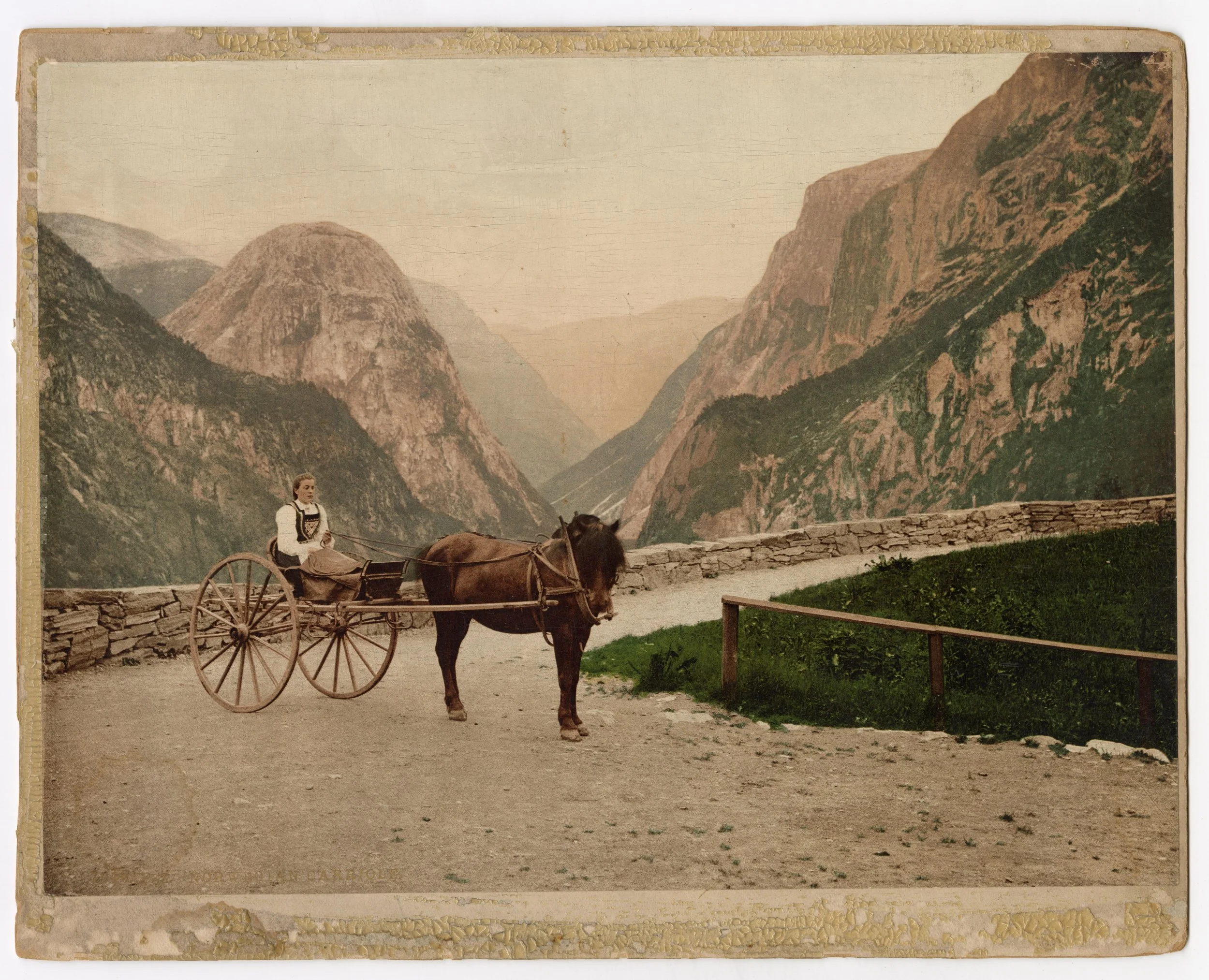
(Farsund, Norway at the turn of the century. Courtesy Norwegian American Historical Society.)
James DeNoon Reymert was born in 1821, the youngest of four children at Farsund, one of the most southerly port cities in Norway. The Reymerts had a long history in this part of Norway. JD's father, Christen Reymert, held the office of Collector of the Port for upward of forty years. The name Reymert itself traces back to the Gothic invasion of Spain, from which the family migrated first to Holstein and then to Norway, where they set their roots, a journey completed over five centuries before JD was born. Interestingly, four generations of Reymerts served in succession as pastors of the same church at Sogne Parish, from 1636 to 1738.
Reymert’s mother, Jessie Sinclair Denoon, was a Scotch lady of the Campbell clan, whose family grounds formed part of the present Argyle estate near the Clyde, where the castle of Denoon stands. The Sinclairs of Scotland trace their lineage to Norman knights who arrived during the conquest of England before settling in Scotland in the eleventh century. By the fourteenth century, the family had risen to the Earldom of Orkney. It was a Sinclair, William St Clair, 1st Earl of Caithness, who founded Rosslyn Chapel in Midlothian in the 1440s, a structure whose carved symbolism has fascinated Masonic scholars and Templar researchers for centuries. The Sinclairs also held hereditary authority over Scotland's stonemasons for generations, a position formalized in charters issued in 1602 and 1628. In 1736, the last Sinclair to hold the title resigned it to the Scottish lodges at the founding of the Grand Lodge of Scotland. Then he was reappointed as its first elected Grand Master. James DeNoon Reymert carried this blood through his mother and was himself a Masonic Knight Templar.
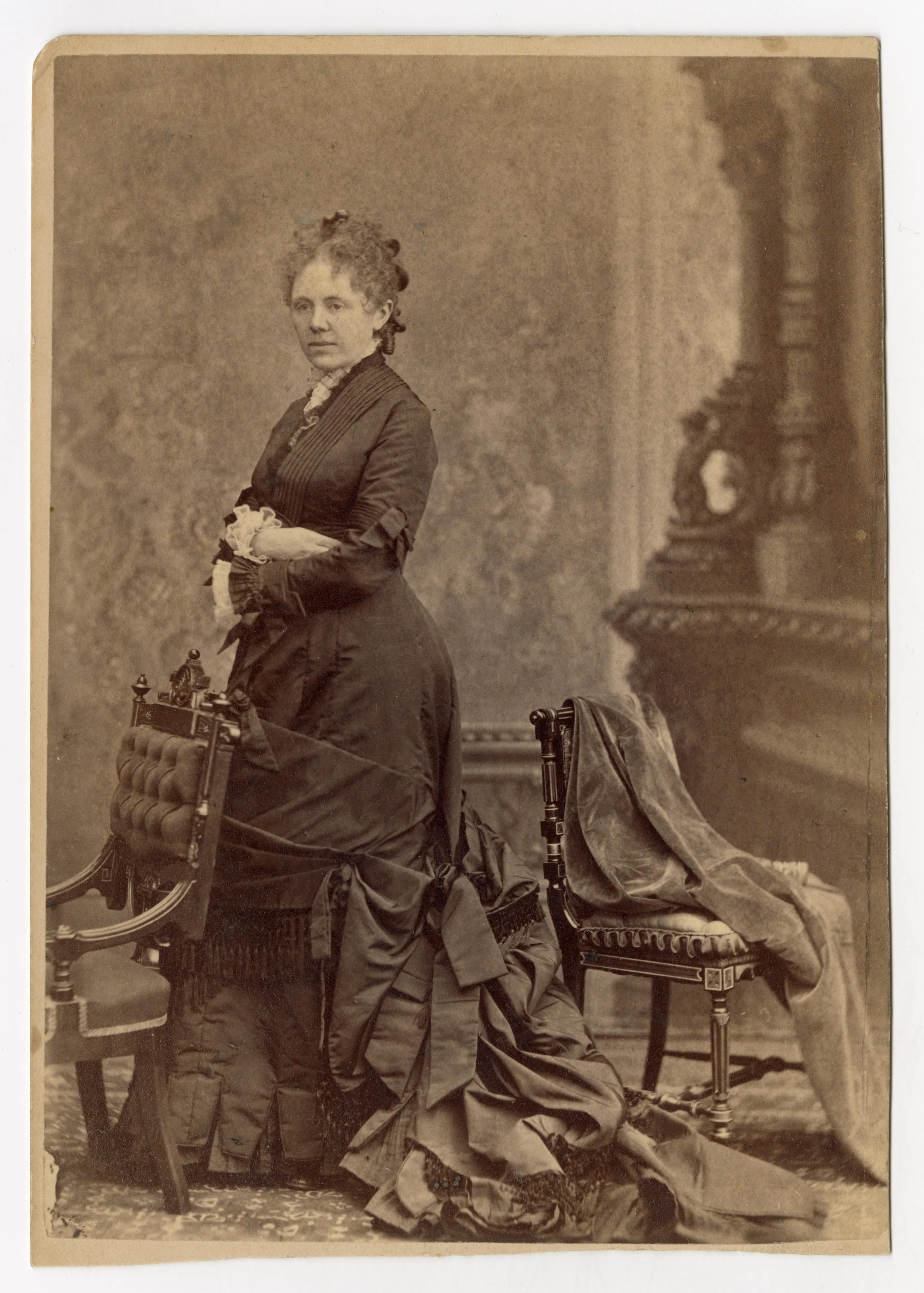
(“Jenny” Reymert. JD Reymert’s mother. Courtesy NAHA.)
The DeNoon family had its own history with America too. Two of Reymert's uncles fought in the American Revolution, with one of them killed in naval service. Another uncle, the Reverend Alexander DeNoon, published writings in favor of American independence, earning enough British hostility that he emigrated during the war. He became pastor of the "Auld Stane Kirk" at Caledonia, New York, where he preached for over fifty years.
At fifteen JD left home. Intended for mercantile pursuits, he completed a course of study at the Commercial College in Christiania, the capital city of Norway, where he was the youngest student enrolled. He returned home with his diploma only to leave again, this time for Scotland where he entered the commercial house of John Mitchell & Co. at Leith. For four years he split his time between duties for the firm and the study of law at Edinburgh, in the offices of Messrs. Murdock & Spencer. While in Edinburgh he lived under the guardianship of his uncle, the Reverend James Young, a minister of the Presbyterian Church.
One day, like millions of people in Europe at that time, JD read a glowing description of America that was enough to make him leave. He struck out for the land of the free and arrived in New York in September of 1842, twenty-one years old, with Sinclair blood, a lofty Norwegian upbringing, an Edinburgh legal education, and an impressive pedigree that would open doors for him.
At the Mercantile Library in New York was a Scandinavian librarian who advised JD to go west, so Reymert sold his best coat for a canal boat ticket to Buffalo and one dollar in cash. The buyer was a Norwegian missionary from the West who promised to follow Reymert and become his patron saint in Wisconsin, a promise never kept. In any case, broken promise or not, Reymert was heading to the mid-west.
On the squadron of canal boats that sailed up the Hudson, Reymert found himself among a promiscuous gathering of Dutch, Swiss, German, and French emigrants. His knowledge of languages made him the medium of communication for the entire group. Ten days of lively talk in five languages carried them to Buffalo, where Reymert arrived with his last cent. There he boarded the steamer Bunker Hill, an old craft by all accounts, frail and shaky, and he worked his passage to Milwaukee partly as a sailor, partly as an engineer. There were no piers or landing places at Milwaukee in those days, so small tug boats sailed alongside out in the lake to take passengers ashore. The city was a dismal looking village of about a thousand inhabitants, yet it served as headquarters for the great Northwestern Territory, a population of 25,000 spread over what would become Wisconsin, Minnesota, and Dakota.
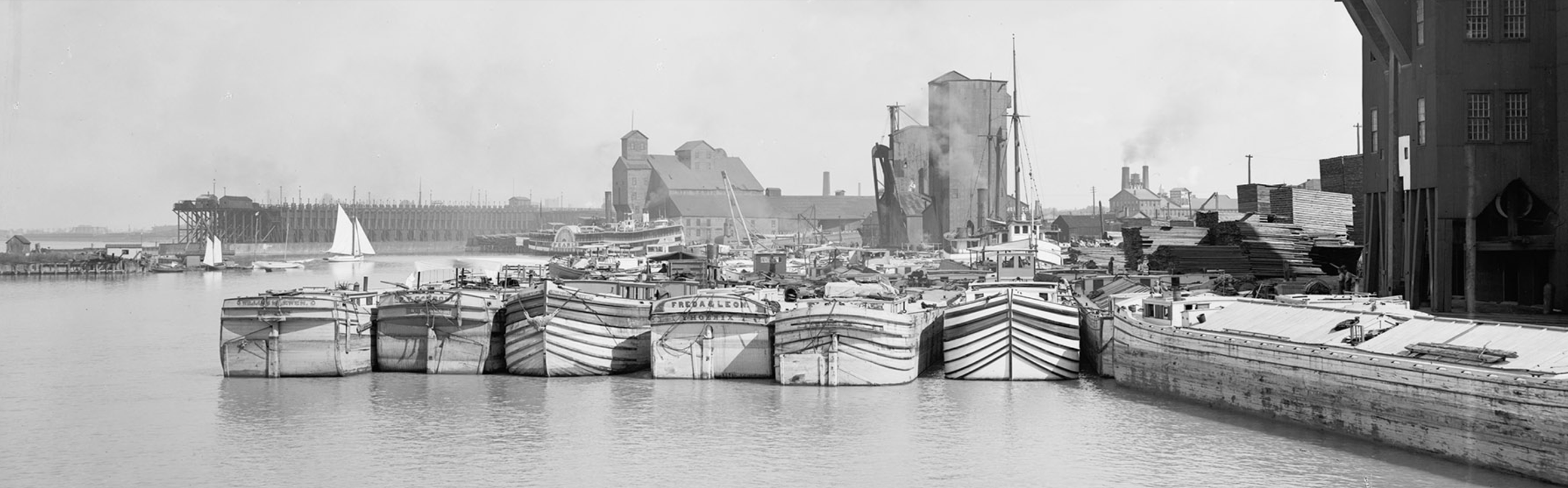
(Canal boats in Buffalo. Courtesy eriecanalway.org)
When a teaching position opened at a local English-speaking school, Reymert, a Norwegian who had just entered the country, took it. His first order of business, according to an old newspaper account, was to establish discipline by throwing out the biggest boy in the class, and then three more after him. The pay was ten dollars a month plus a "board around" arrangement, which meant sleeping and eating at the homes of his students' families in rotation. At the end of the term he collected his salary in scrip, practically worthless for anything but taxes.
Reymert eventually married Anna Caspara Hansen, the daughter of a well-known fencing master, and settled on a farm at the town of Norway in Racine County. Within a decade he had built it into the sprawling estate where the cholera epidemic of 1852 would find him.
Another story told about Reymert is this: Early one spring morning in 1844, when the ice came down with the torrent and the Milwaukee River rushed along swelling over its borders, a little apple-boy with his basket attempted to cross a frail floating bridge. He fell, and while trying to save his apples, slipped into the river. The basket floated on the water, but the boy was gone. Reymert threw off his coat and hat and plunged into the icy waters where the boy had fallen. He perceived the eddy had sent the boy back under one of the hollow floats on which the bridge rested, and he was right. Reymert dove down below the bridge and miraculously brought the boy out alive.
By the early 1850s, Reymert had established himself as more than a farmer. He had studied law in Edinburgh, and in Wisconsin he put that training to use whenever opportunity or necessity required it. He tried cases and built a reputation as the kind of man who could handle whatever came at him.
For example, in 1851, an old Norwegian shot his son-in-law dead. The body was found the following spring near a fallen tree after the snow melted. The old man had sought Reymert before he was indicted for murder to plead his case to someone who could help. He said it was an accident and that he had concealed the body for fear of the consequences. The court assigned him counsel and sent for Reymert to aid in the defense. The trial was long and painful, resulting in conviction. The bereaved daughter had just become a mother. The jury brought in the verdict near midnight. The courtroom was crowded, and the big-hearted judge almost shrank from his task. The doomed man remained motionless and speechless while the jury permitted his children to take their last farewell. Reymert, profiting by the general emotion in the room, immediately drew up a petition to the governor for an unconditional pardon. Judge, jury, District Attorney, and all present signed it. The man was pardoned then and there.
These are the stories told about James DeNoon Reymert in a biographical profile originally published in the Phrenological Journal in February 1872 and reprinted in the Waukesha Freeman on June 19, 1873, more than twenty years after the events it describes. He sold his coat and built an empire. He dove into a frozen river for a stranger's child. He convinced an entire courtroom to pardon an admitted and convicted murderer on the spot. JD Reymert is a man of action, a man of nerve, a man who could talk anyone into anything. It reads, from beginning to end, like the profile was trying to make sure the super-hero version of Reymert was the one that survived.
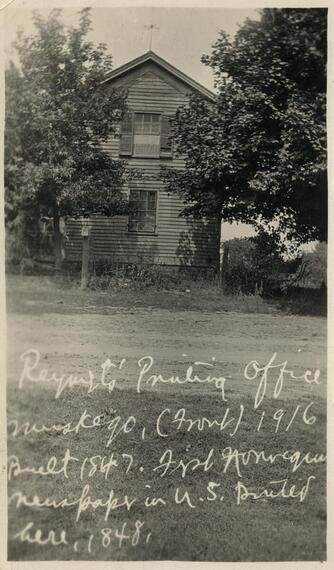
(JD Reymert home and print house inMuskego, WI. Courtesy Wisconsin Historical Society.)
In 1847, Reymert founded the Nordlyset with Colonel Hans Heg and Søren Bache. It was the first newspaper published exclusively in the Norwegian language in America. The name meant "Northern Light," and its reach extended to every Norwegian settlement in the territory. For a scattered immigrant population with limited English, a Norwegian-language newspaper was more than a convenience. It was the primary channel through which information moved: land availability, political candidates, shipping schedules, community news. Whoever controlled that channel controlled what Norwegian settlers knew and when they knew it.
The following year in 1848, Reymert was elected to the Wisconsin Constitutional Convention. While there he authored the Article on Suffrage and originated the clause that "no distinction shall ever be made by law between resident aliens and citizens in reference to the possession, enjoyment, or descent of property." This meant that Norwegian immigrants who had not yet naturalized could still buy, hold, and inherit land in Wisconsin. For a man who would spend the next decade building an immigration pipeline, it was foundational legislation.
He was elected to the first state legislature in 1849, when the statutes of Wisconsin were formed. From there the offices accumulated: Justice, Superintendent of Schools, Supervisor. He returned again and again to the Assembly and to the Senate, and he became the first Vice-Consul for Sweden and Norway for the Western States,. Importantly, he was a friend of Stephen A. Douglas.
In 1853, Reymert ran for the Wisconsin State Senate. The Waukesha press accused him of importing two hundred Norwegian immigrant voters to swing the election. Reymert defended himself in a letter to the Daily Free Democrat, claiming only forty had been naturalized legally. The newspaper was unimpressed and it called him a demagogue playing the immigrant discrimination card for political cover.
Then came the fight that is important for this story. In 1854, the Wisconsin legislature debated whether to continue funding its immigrant agencies. These were state-operated offices in New York and Quebec, staffed with agents who met arriving ships, directed immigrants to Wisconsin, and helped them settle. The system also employed traveling agents who moved through immigrant communities recruiting settlers. Reymert fought to keep these agencies open. He argued on the floor of the legislature that Wisconsin's growth depended on maintaining this infrastructure, that the flow of immigrants from Europe through the eastern ports and into the western territories required active management.
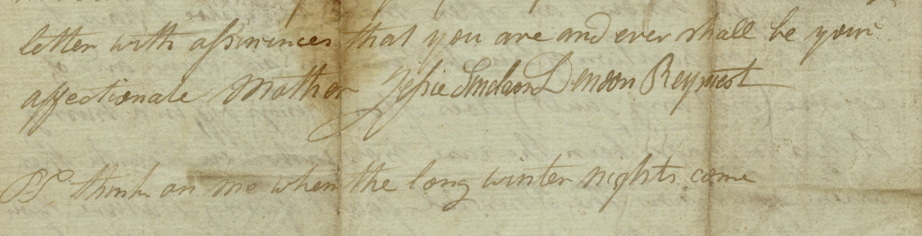
(A snippet of a letter from Jeanette SInclair DeNoon to her son JD Reymert asking him to think on her when the long winter nights come. Courtesy NAHA.)
Reymert won the argument. The agencies stayed open. The pipeline he had been building since Nordlyset kept its state funding, its institutional backing, and its network of agents stretching from the ports of Quebec and New York to the settlements of the Wisconsin frontier. It was, in everything but name, a colonization apparatus. Within three years of this legislation's passing, Reymert would be discussing plans with Caleb Cushing for "similar colonization of the Wisconsin side" of the St. Croix Valley. Cushing had been investing in land and mining on the Minnesota side of the valley since 1845 and Reymert had the infrastructure to bring settlers to Cushing’s side of the bank.
Reymert was soon named Receiver of the U.S. Land Office at Hudson, Wisconsin, and later transferred to St. Croix Falls. He was appointed U.S. Sub-Treasury and Disbursing Agent for the Northwestern States, and he served as District Attorney. Each position carried the same features: control over money, land, or both. For a man with the right ambitions, these were access points, and Reymert proved to be quite ambitious. By the time he left the land office at Hudson, $6,000 in federal funds could not be accounted for.
In 1860, Reymert ran for Congress on the Douglas Democratic ticket. Stephen Douglas had staked his presidential campaign on squatter sovereignty, the principle that territorial populations should decide the slavery question for themselves. Aligning yourself with squatter sovereignty was typically seen as a pro-slavery position. Reymert, who had earlier supported the Wilmot Proviso banning slavery in territories acquired from Mexico, had reversed himself, and because of this, lost the race badly. The Wisconsin State Journal observed that he "got but little over a quarter of the vote in the town where he resides, which shows that those who know him best trust him least," a characterization that would seem to be accurate for the rest of his life.
Within a year of losing the congressional race, Reymert was gone from Wisconsin. The Waukesha Freeman on June 19, 1873 later reported that "his professional connection and business with the Hon. Caleb Cushing and other Eastern eminent jurists brought him often to New York, and in 1861 he removed to this city." Then, almost in passing, the profile addressed the Hercules Mutual Life Assurance Society, the first and only company Reymert would form after arriving in New York at Cushing's direction. Reymert, the Freeman reported, had "organized the Hercules Mutual Life Assurance Society of the U.S. as counsel." He "afterward took the presidency of that Society at the solicitations of clients who had invested therein." Having "firmly established that Society, and with the entire approval of all concerned, he has now retired from that position, and is again engaged in a large and lucrative legal practice."
Five days later, on June 24, 1873, a New York judge Danforth ordered the dissolution of the Hercules Mutual Life Assurance Society, describing it as "a mythical corporation, having no existence outside the treacherous memory of the Attorney-General." The Freeman published its glowing profile of Reymert while the courts were killing his company.
The Phrenological Journal profile that reported Reymert's move to New York, the same fluff-piece later reprinted in the Waukesha Freeman that gave us the cholera epidemic hero, the man who jumped into the freezing river to save the apple-boy, and the midnight pardon for a convicted murderer, made no mention of the $6,000 that had gone missing from the federal land office at Hudson, nor the court case that followed. That case reached the federal courts as United States v. Reymert, Case No. 16,149, Circuit Court, Southern District. Reymert lost that case and agreed to repay the government. But then, in 1877, Congress passed House Resolution 3063, releasing Reymert's bondsmen from the obligation to repay the debt. The resolution is in the Congressional record, and the money was never recovered. How a disgraced land office receiver in Wisconsin secured an act of Congress to clear the debt is a question the record does not answer, but I suspect men like Caleb Cushing might have had a hand in the arrangement.
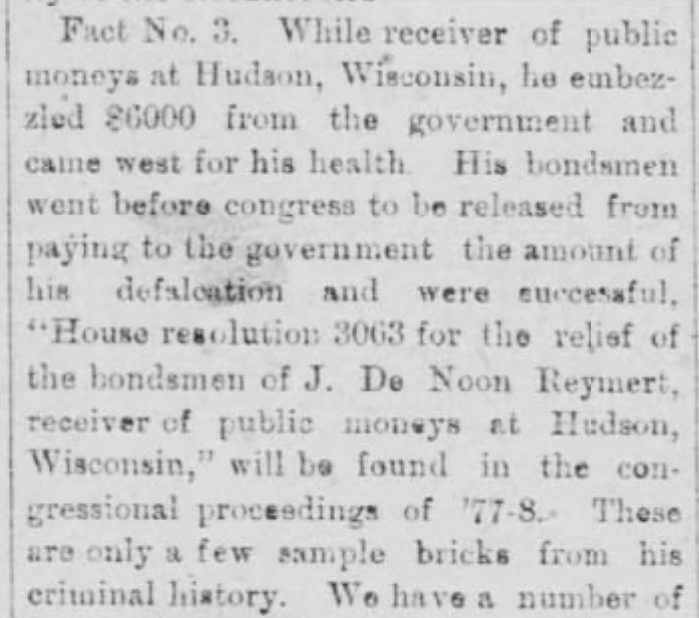
(A snippet of one of many exposes on JD Reymert by the Arizona Weekly Enterprise. This one from Nov. 4 1882.)
Caleb Cushing, by 1861, had been building his own empire in the St. Croix Valley for sixteen years. He organized the St. Croix and Lake Superior Mining Company with Rufus Choate and Robert Rantoul Jr. in 1845. In Polk County, Minnesota he had accumulated tens of thousands of acres. At one point he even attempted to manipulate the state line of Wisconsin, hoping to carve out more territory that he could control. He had been corresponding with JD Reymert, who controlled an immigration pipeline stretching from Quebec and New York to the frontier settlements of Wisconsin.
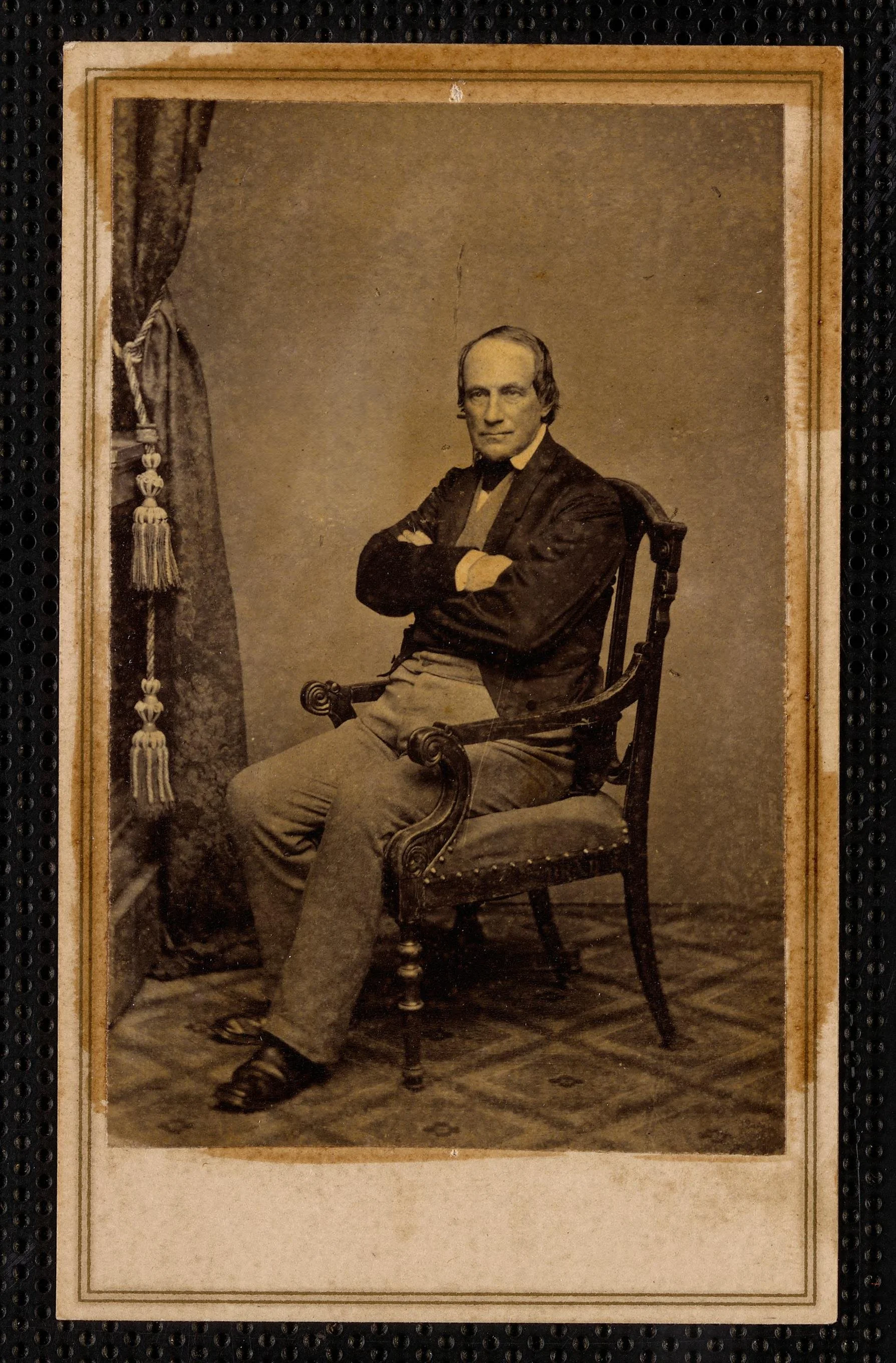
Caleb Cushing. Courtesy Library of Congress.
Reymert had something Cushing needed. He could move people. He had a propaganda machine in his newspaper, the political offices, the immigrant agencies, the language skills, and the trust of a community that followed Norwegian-language publications the way English-speaking Americans followed their own. Reymert had spent fifteen years building that infrastructure and now Cushing was going to put it to use.
This research takes time. If it added something to your day, you can buy me a coffee. Thank you!

If you’ve ever felt the urge to rock a KGC treasure template, now is your chance!
Sources
"James Deenoon Reymert," Phrenological Journal, reprinted in Waukesha Freeman (Waukesha, Wisconsin), June 19, 1873.
Letter, Jeanette Sinclair Denoon Reymert to James DeNoon Reymert, August 14, 1839, Christiansund, Norway. Norwegian-American Historical Association.
Letter, James DeNoon Reymert to August Reymert, November 1876, Arizona Territory. Norwegian-American Historical Association.
"St Clair Family," Rosslyn Chapel official website. https://www.rosslynchapel.com/about/st-clair-family/
"Letter from Senator Reymert," Daily Free Democrat (Waukesha, Wisconsin), November 23, 1853, page 2.
"What Is To Be Gained By Lying!" Waukesha Republican (Waukesha, Wisconsin), November 2, 1853, page 2.
"Wisconsin Legislature," Wisconsin State Journal (Madison, Wisconsin), March 9, 1854, page 3.
"The Plain Dealer: Democratic State Convention," Waukesha Republican (Waukesha, Wisconsin), August 21, 1855, page 2.
"Mr. Reymert Defines His Position for the Norwegian Voters," Wisconsin State Journal (Madison, Wisconsin), September 19, 1860, page 2.
Sunday Mercury (New York), November 16, 1873, page 3. Court-ordered dissolution of the Hercules Mutual Life Assurance Society by Judge Danforth, June 24, 1873.
United States v. Reymert, Case No. 16,149, Circuit Court, S.D.
House Resolution 3063, 1877. Congressional Record.
"Death of J.D. Reymert," The Minneapolis Journal, April 24, 1896, page 10.
Alice E. Smith, "Caleb Cushing's Investments in the St. Croix Valley," Wisconsin Magazine of History, Vol. 28, No. 1 (September 1944): 7-19.